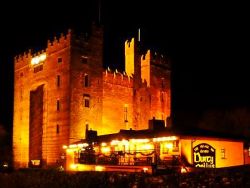
Medieval Irish Castles
How many medieval Irish Castles are there? Too many
to count. Apparently, over 30,000 castles and castle ruins are dotted all over
the Irish landscape.
There are some large, significant and well-known ones such
as Bunratty Castle in County Clare, or Blarney Castle in County Cork.
Oranmore Castle, County Galway, right on the seashore, was once of military importance during the siege of Galway in 1649. Nowadays the castle is privately owned.
But many
people don't realize that beyond those large visitor attractions Ireland is
actually peppered with smaller local castles.
Many of the medieval castles are ruins of course, but others
have been lovingly restored.
In this section, let us introduce you to everything
we know about these medieval Irish castles.
Later on, other types of castles were built in later
architectural styles. We are discussing those on the page 'Big Houses and
Revival Castles'.
Scroll down the page for plenty of links to all our pages on castles in Ireland!
But first, let's talk history.
How did it all start?
Before the arrival of the Normans in Ireland,
the prevailing style of building fortifications was the building of different types of forts, such as the gigantic stone forts on the Aran Islands,
or ring forts forts made by piling up earth. Gealic clans used to live in
wooden or wattle and daub housing inside the protection of these forts, and
there was enough space for cattle as well.
When the Vikings started to settle in Ireland
in the mid-eighthundreds, they, too started building wooden fortifications, so
called longphorts. At the Viking settlement in Dublin they built a wooden
fortification on the site of what today is Dublin Castle.
Why did they need
fortified residences in the first place you might ask. Well, in those
days there was a lot of conflict between neighbouring families or tribes. You could never be sure to be safe. This
continued to be true into medieval times and was the reason why fortified Irish castles were built by
the Normans.
Parke's Castle in
County Leitrim is beautifully restored and a great example of a late
medieval castle worth the 25 minute trip from Sligo town.
The story of Irish
castles as such starts with the Normans. They arrived first in 1169 AD. Because they had better war technology than the
Irish who did not have armour at the time, and used inferior weapons such as
axes compared to the invaders, the Normans were very successful. Many Irish
chieftains had to accept the Normans as
overlords and pay them dues while existing side by side.
The castle at Shrule, County Mayo on the photo above
was built by Normans in 1238 and held out through many a battle.
Subscribe to our newsletter (left column) and get to take our free course on Irish castles!
The Normans were extremely adaptable. Wherever they
went, they became fully integrated into the country within a couple of hundred
years. Once in Ireland, some Normans started adopting the customs of the Gaelic
tribes. They might have started to speak Irish, too. Other Normans spoke Welsh,
French or English.
There was quite a cultural melting pot there among the
Normans and with that it was no surprise that wherever they went, they
picked up technologies and brought them with them.
Among the technologies the Normans brought to Ireland was
the building of cut-stone fortified Irish castles. The building of these
castles started about a generation after their arrival.
Bunratty Castle at Bunratty, County Clare, Ireland, is one of Ireland's best medieval castles.
After conquering enemy territory, the Normans would first
erect a wooden fortified structure, a Motte and Bailey, surrounded by
wooden palisades for additional layers of defense. This would later be followed
up by building a fortified castle.
These castles started to appear in Norman strongholds in
Ireland from the 13th century. You will find them in fortified towns,
with good and relatively intact examples being Trim, County Meath, Kilkenny,
Ballymote in County Sligo and Athenry in County Galway, see also the
photo above of Shrule Castle in County Mayo.
Cahir Castle, at Cahir, County Tipperary, was once
considered Ireland's safest castle.
So called Norman tower houses, a form of fortified
country residences, which is peculiar to Ireland and Scotland, started to
appear in Ireland in the 13th and 14th centuries. But although it had been the
Normans that introduced the technologies of building castles, the Gaelic tribes
adopted them as well. The Gaelic O’Flaherty’s in Galway, for example built a
fine tower house, Aughanure Castle, in Oughterrard.
Limerick Castle, or King John's Castle, recently renovated and updated with a high tech exhibition centre is a great day out for the whole family.
Irish Castles Are Changing
With the existing war technologies of the time, these
castles were very defendable. After the invention of guns and canons
however, fortified castles became obsolete. These were gradually introduced
in Ireland throughout the 17th century. During the Cromwellian
invasion of Ireland which started in 1649, heavily fortified towns such
as Waterford and Wexford were won with heavy assault guns.
Medieval Castle Visits
King John's Castle Limerick
Athenry Castle
Bunratty Castle
Claregalway Castle
Cahir Castle
Annaghdown Castle
Dunguaire Castle
Aughnanure Castle
It became clear that medieval castles designed for siege
warfare could no longer be defended against an army. You might just about
be able to defend against an angry mob of peasants!
The conclusion was that you might as well live comfortably
and show off your wealth. This idea formed the beginning of a new era.
Some medieval castles were remodelled at this stage, for
example Kilkenny Castle or Roscommon Castle below.
Castles Of Both Old And New
The Ormond Castle
Kilkenny Castle
Parke's Castle
Roscommon Castle
Others had been destroyed during or after the Cromwellian
conquest of Ireland when a lot of castles were 'decommissioned',
rendering them useless by destroying defensive staircases and battlements.
With the onset of the new era of castle building, a lot of surviving medieval Irish castles were now abandoned for new builds of comfortable and spacious country mansions built
in different styles.
The new building styles for big houses and revival castles
varied and usually corresponded with whichever architectural style was
fashionable in Britain at the time.
The photo above shows a great example of a castle and big house existing side by side. You
can see Ballycurrin Castle (on the left, covered in ivy) and Ballycurrin House
in County Mayo, Ireland, standing close together on the same site.
If you enjoyed reading about Irish castles as much as we enjoyed ourselves putting this content together for you, please take some social action! Thanking you.
Return to the top
of this page.
Return to the Homepage.
We invest a lot of our own funds and free time into this website so that you can find out about Irish culture, heritage and history.
Please return the favour and help us cover our cost by clicking on Google ads and/ or buying us a cup of coffee! Thank you so much in advance.
Warmest regards, Colm & Susanna
|
|
|
|
Enjoy this page? Please pay it forward. Here's how...
Would you prefer to share this page with others by linking to it?
- Click on the HTML link code below.
- Copy and paste it, adding a note of your own, into your blog, a Web page, forums, a blog comment,
your Facebook account, or anywhere that someone would find this page valuable.
|
|
|
|
- Home
Customs and Traditions
Travel
Music
Heritage
About This Website